Product design case study

SYNERGY

SYNERGY is a B2B system for managing outdoor and indoor lighting. The initial requirements described the operation of configured lighting in detail, but did not connect site surveys, equipment selection, installation and commissioning. Following user surveys and scenario development, the team clarified the roles and brought these stages into a single workflow.

Role Product Designer · Period 2022–2023 · B2B / Enterprise

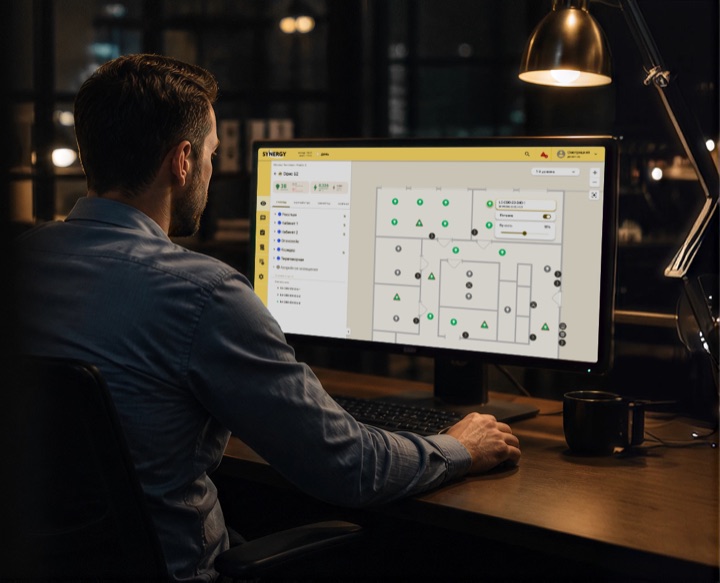
An operator working with SYNERGY on a large screen

Project overview

My role and the team

My contribution

I conducted research and user surveys, took part in hallway testing, wrote user stories, and designed interfaces and interactive prototypes. I checked hypotheses with an analyst and users, participated in some testing, handed designs over to developers and carried out design reviews.

Team

The Product Manager was responsible for product direction, priorities and agreeing functionality with the business. The client's analyst helped explore the domain and align business processes. Frontend and backend developers and QA were involved in implementation.

Period

2022–2023

Status

Project completed at version 1.0

Early requirements · Research

The early requirements covered system operation, but not the full path to commissioning a facility

The early materials focused on the map and equipment, lighting control, monitoring, incidents and analytics — work at a facility that was already set up. Comparing the requirements with the actual process revealed that site surveys, equipment selection, installation and commissioning were not yet connected in a single workflow with clear handoffs between participants.

A gap in the product model

Commissioning was not described as a single process

The early requirements did not fully account for the actual facility commissioning process.

What was covered

Operating a configured facility

Map and equipment
Lighting control
Monitoring and incidents
Analytics and reports

What remained disconnected

Four stages without an end-to-end workflow

Site survey
Equipment selection
Installation
Commissioning

Research · Role model

New roles covered the essential stages of commissioning

User surveys, discussions with the analyst and scenario development showed that the initial allocation of responsibilities was insufficient for commissioning a facility. The process needed explicit steps for surveying the site, reviewing the findings, selecting and approving equipment, installation, commissioning and handing the configured facility over to the operator. Without these steps, there was no clear path to bringing a facility into operation.

Early model

6 roles with broad responsibilities

Supervisor · Operator · Administrator · Installer · Auditor · Commissioning specialist

The auditor only checked the installer's work. The boundaries between surveying, selection, installation and configuration remained unclear.

After research

8 roles with distinct responsibilities

Supervisor · Administrator · Auditor · Manager · Owner · Installer · Commissioning specialist · Operator

Added: manager and owner

The responsibilities of the auditor, installer, commissioning specialist, operator and administrator were linked to the essential stages and areas of accountability.

Outcome

The essential workflow became part of version 1.0

The team connected project creation, site surveys, equipment selection, installation, commissioning and handover into operation in a minimal end-to-end workflow. Advanced operator functionality remained part of the target concept.

Version 1.0

  • project creation and assignment of participants;
  • site survey;
  • equipment selection;
  • installation and recording the outcome;
  • commissioning;
  • handover of the configured facility into operation.

Target concept

  • device control through map widgets;
  • display of lighting zones;
  • creating and tracking service requests;
  • video surveillance;
  • use of weather data;
  • an expanded event log;
  • visualisation of façade lighting.

My work resulted in a process role model, user stories, interfaces and prototypes for different working contexts, alongside development support and design reviews.